AI-Driven Workflow Automation Is Growing Rapidly—So Why Are Product Teams Still Struggling?
AI-driven workflow automation is quickly becoming a core capability for modern product organizations. The adoption of AI in software development continues to accelerate, with many teams already relying on AI-powered tools to enhance productivity across coding, testing, and delivery processes.
Yet a significant challenge remains. While more than 90% of organizations plan to increase their investments in AI over the next several years, only a small percentage consider themselves mature in integrating AI across complete end-to-end workflows. This disconnect helps explain why many teams continue to experience friction despite widespread AI adoption.
One of the primary reasons delivery still slows down is the way work moves between systems and teams. Most organizations continue to depend on manual ticket creation as the connection point between design, planning, and development. Product managers often translate Figma designs into engineering tickets, convert product requirement documents into user stories, and document testing observations as bug reports. These responsibilities frequently require a level of technical detail that product managers may not always possess, creating gaps early in the delivery process.
As a result, tickets often lack critical technical context, include vague acceptance criteria, or leave room for interpretation. Developers are forced to reinterpret requirements, clarification cycles increase, and QA teams uncover missing details late in development. The issue is fundamentally structural rather than operational.
Why AI Fails at Workflow Boundaries in Software Development
AI in software development excels at improving execution within specific tasks, but it often falls short when coordination across workflows is required. Research from McKinsey indicates that developers can complete certain activities up to twice as fast with AI assistance. However, those productivity gains decline significantly when requirements are unclear, incomplete, or poorly structured.
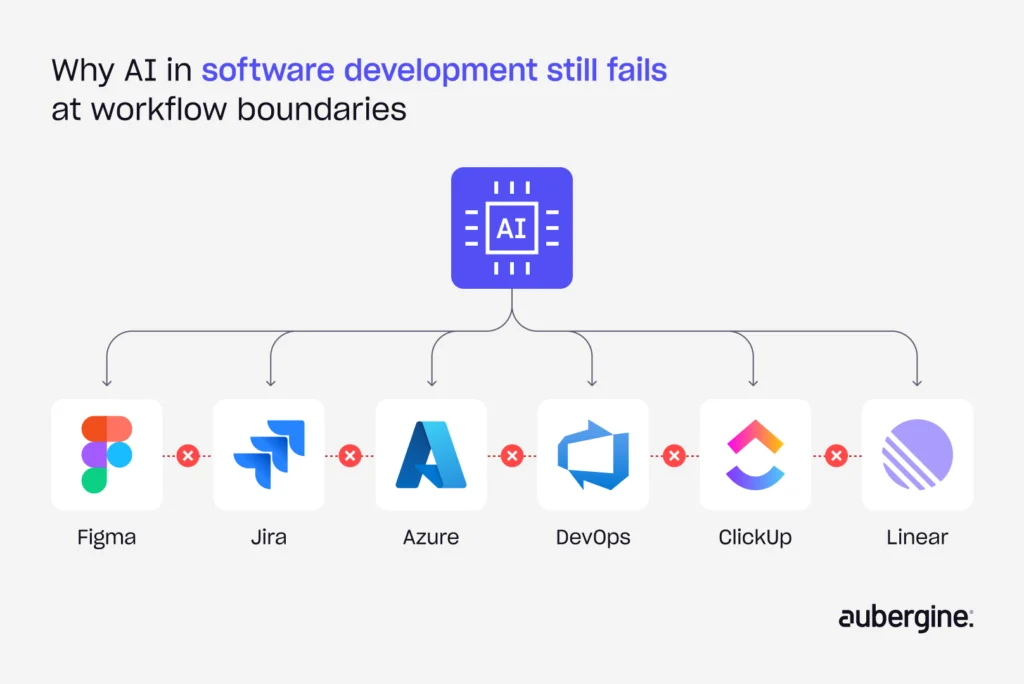
AI tools work effectively within well-defined environments, but product development depends on coordination across multiple roles, systems, and responsibilities. Product managers define scope but may not always communicate implementation-level details. Developers depend on tickets that sometimes lack sufficient clarity, leading to repeated discussions and clarification requests. At the same time, updates occur across multiple platforms, making alignment increasingly difficult to maintain.
Visual representation of AI software development issues at workflow boundaries, emphasizing reasons for project failures.
These weaknesses become especially visible during testing. QA teams frequently encounter missing edge cases, incomplete user journeys, and unclear expected outcomes. Friction consistently emerges at workflow transition points, including design-to-development handoffs, requirement-to-implementation transitions, and testing-to-debugging processes.
A seemingly minor gap in ticket creation often triggers a chain reaction that expands into recurring inefficiencies throughout the entire delivery lifecycle. In most cases, workflow breakdowns occur between systems and teams rather than within them.
If you are exploring this topic further, you may also find our perspective on why AI alone cannot solve product execution challenges valuable, as it examines why technology without structured workflows often falls short of expectations.
AI-Driven Workflow Automation: How We Accelerated Ticket Creation by 70–90%
At Aubergine, we do not approach development through blind automation. Instead, we focus on understanding how teams actually operate, identifying where workflows slow down, and uncovering what information gets lost during transitions.
This philosophy guided our approach to solving workflow inefficiencies. Rather than beginning with a predefined solution, we worked closely with product teams, studied their daily operations, and analyzed where execution repeatedly broke down.
The result was Project Trio—an AI-driven workflow automation platform built specifically for product teams. More importantly, it was designed as a response to a recurring and measurable problem.
Project Trio is far more than a standalone tool or advanced prompting interface. It connects AI assistants directly with the systems product teams already depend on, including:
- Figma
- Jira
- Azure
- DevOps
- ClickUp
- Linear
Our objective was not simply to generate better AI outputs in isolation. Instead, we wanted to ensure work could move smoothly through every stage of the product lifecycle without losing critical context during handoffs.
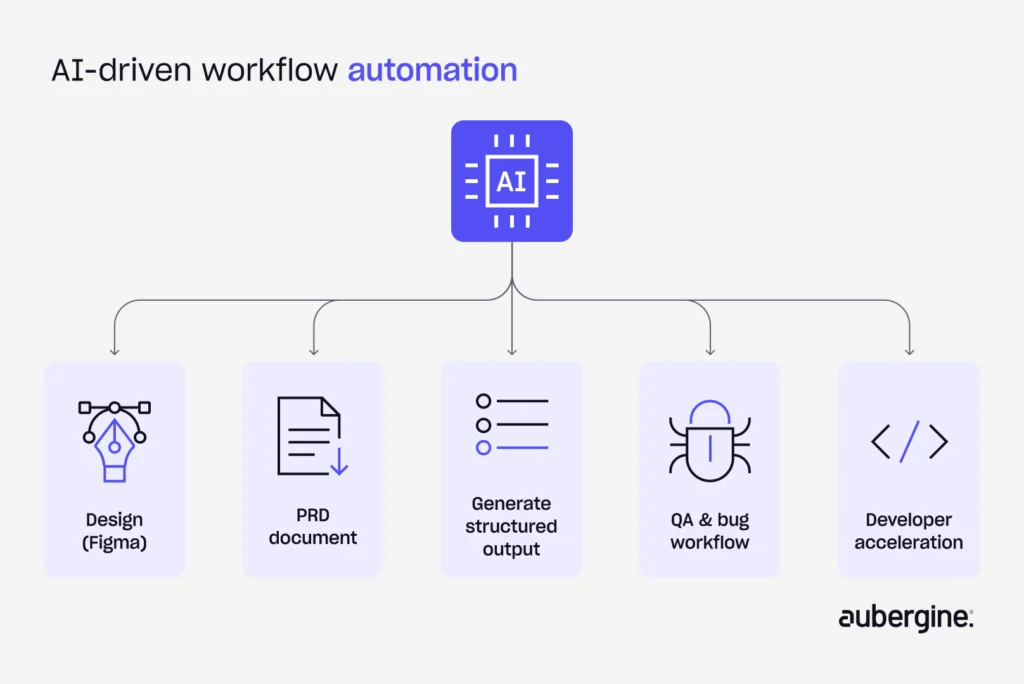
Project Trio enables structured automation across essential product development workflows, including:
- Design to tickets
- PRD to user stories
- Stories to development tasks
- Test documentation to bug reports
- Tasks to code generation
The real differentiator is not automation alone, but the way automation integrates into existing workflows. Rather than forcing teams to adopt entirely new processes, Project Trio supports established ways of working while eliminating the friction that slows execution.
The outcome is a reliable system that helps teams improve daily productivity while maintaining consistency, predictability, and trust.
How We Automated Workflows Without Disrupting Existing Systems
We intentionally designed the platform to work alongside existing tools rather than replacing them. To achieve this, we implemented the Model Context Protocol (MCP), which acts as a bridge between AI systems and product development platforms.
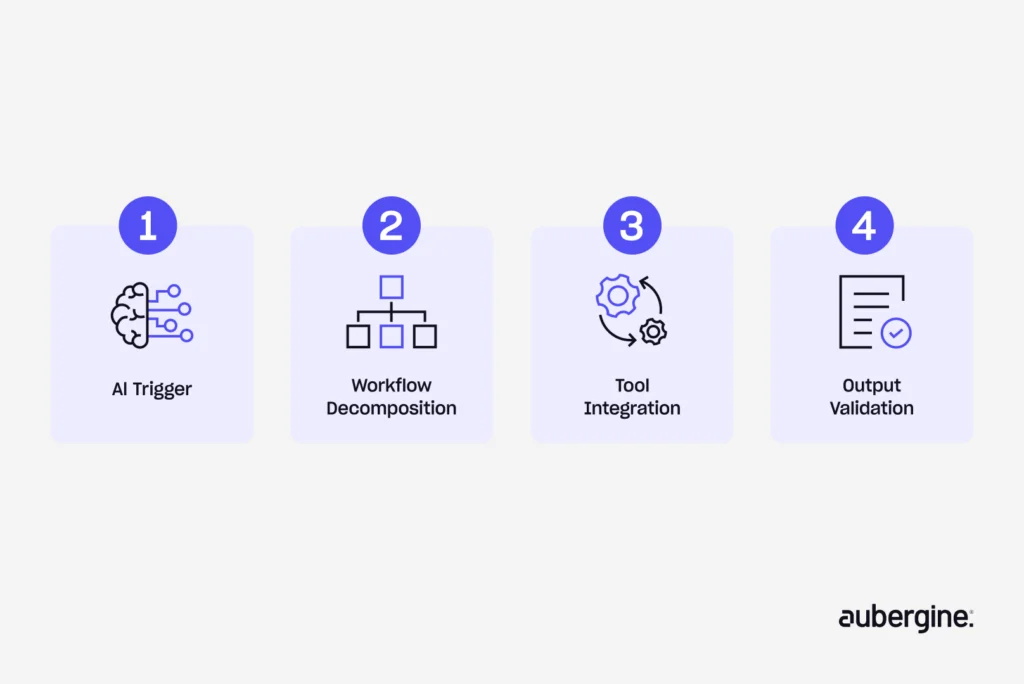
Each workflow follows a structured sequence:
- An AI trigger initiates the workflow
- The workflow is divided into smaller execution steps
- Each step connects with a specific tool or platform
- Outputs are validated before moving to the next stage
Infographic illustrating the key steps involved in developing a successful product, from idea generation to market release.
This framework ensures that automation remains both predictable and dependable. Teams interact with a guided workflow system rather than a generic chatbot experience, significantly improving usability and confidence.
The Shift From AI Assistance to AI-Driven Workflow Automation
Transitioning from AI assistance to true AI-driven workflow automation required a move toward structured execution.
As we worked through real-world product workflows, it became evident that flexible prompting alone introduced excessive variability. Reliable automation requires clearly defined processes that guide work from one stage to the next.
Based on these findings, we built the system around several core principles:
Sequential Execution
Every step depends on the successful completion of the previous stage, creating a logical and traceable workflow.
Atomic Operations
Tasks are broken into small, precise actions that reduce ambiguity and improve reliability.
Validation Checkpoints
Quality controls are embedded throughout the process to identify issues before they escalate.
Human Confirmation Gates
Strategic approval points provide oversight and accountability where necessary.
Error Recovery Paths
Workflows include mechanisms for handling failures without disrupting the broader process.
This structure improves reliability, consistency, and scalability. AI systems perform significantly better when operating within clearly defined execution frameworks.
Real-World Applications of AI-Driven Workflow Automation in Product Development
Visual representation of AI-driven workflow automation, showcasing various stages and their interconnections.
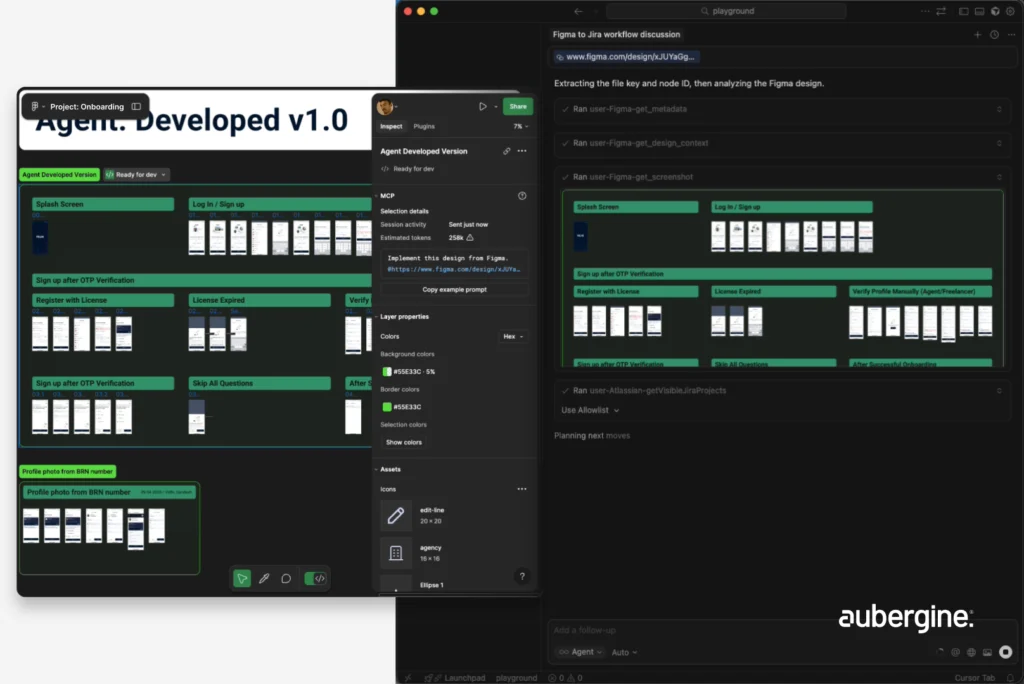
Design-to-Development Workflow
Teams frequently spend substantial time manually converting designs into development tickets. This process often introduces interpretation gaps and inconsistencies.
We automated design-to-ticket conversion to generate structured tickets complete with detailed requirements and acceptance criteria. This improved alignment between design and engineering while reducing repetitive clarification cycles.
PRD-to-Story Workflow
Important details are often lost when product requirement documents are translated into user stories.
We automated PRD processing to create structured stories that preserve business intent while incorporating implementation-ready detail. This reduced ambiguity and improved consistency across teams.
QA and Bug Management Workflow
Bug reports often suffer from inconsistent formatting and missing information, which slows troubleshooting efforts.
We standardized bug creation by transforming testing outputs into structured issues containing reproduction steps, expected outcomes, and supporting context. This improved debugging efficiency and accelerated resolution times.
Developer Acceleration Workflow
Developers frequently spend valuable time configuring environments and creating boilerplate structures before beginning actual implementation work.
We introduced task-to-code automation to reduce this overhead. Developers receive a structured starting point, allowing them to focus more of their effort on solving meaningful technical challenges.
When Workflow Automation Becomes a Competitive Advantage
The benefits of workflow automation extend far beyond simple productivity gains. They impact speed, quality, and overall developer experience.
The app displays various categories of applications available for download and use.
Teams experience significant time savings as workflows that previously required hours can now be completed in minutes.
Quality improves through standardized ticket structures, clearer acceptance criteria, and stronger traceability across systems. Research from Deloitte suggests that organizations implementing structured automation often achieve operational efficiency improvements of 30–40%, which closely aligns with our observations across product delivery workflows.
Developer experience improves as well. Reduced context switching and clearer requirements allow engineers to spend more time building and less time coordinating.
Manual vs AI vs AI-Driven Workflow Automation: What Delivers the Best Results?
| Criteria | Manual Workflow | Generic AI Chat Prompts | Project Trio MCP Workflow Server |
|---|---|---|---|
| Speed | Slow with significant coordination overhead | Faster but inconsistent | Fast, repeatable, and scalable |
| Consistency | Highly dependent on individuals | Varies based on prompt quality | High due to structured execution |
| Traceability | Weak cross-system visibility | Partial visibility | Strong connections across workflows |
| Quality Control | Human-dependent and often delayed | Inconsistent validation | Built-in checkpoints and safeguards |
| Failure Handling | Requires manual rework | Unclear recovery mechanisms | Defined recovery paths |
| Human Oversight | High manual involvement | Frequently overlooked | Intentional approval processes |
| Scalability Across Teams | Limited | Moderate | High through reusable templates |
The fundamental difference lies in structured execution versus workflow variability.
How This Approach Benefits Teams and Clients
For internal teams, this model improves day-to-day execution by reducing manual work and eliminating ambiguity at critical handoffs.
Implementation-ready tickets reduce communication overhead between product, engineering, and QA teams. Built-in validation helps minimize defects and identify issues earlier in the process. As a result, teams spend less time coordinating and more time delivering value, leading to more predictable and consistent delivery cycles.
The app displays various types of software, highlighting their features and functionalities in a user-friendly interface.
For clients, the benefits are equally significant.
Clearer requirements and standardized workflows improve delivery speed while reducing iteration cycles. Output quality improves from the outset, project timelines become more predictable, and less effort is spent on clarification and rework.
This allows client teams to focus on strategic decisions and business outcomes rather than administrative coordination.
Our Key Learnings From Building AI-Driven Workflow Automation
The desktop email application is open, displaying a list of messages and a selected email for viewing.
Our experience revealed several recurring principles that continue to shape how we design reliable automation systems.
Over time, we learned that success depends less on crafting better prompts and more on designing workflows that are structured, validated, and deeply integrated into existing processes.
Structure Matters More Than Prompting
Clearly defined workflows consistently outperform ad hoc prompting strategies, particularly as systems scale.
Validation Is Essential
Built-in checkpoints help identify issues early and maintain quality throughout execution.
Human-in-the-Loop Builds Trust
Strategic approval stages provide accountability while preserving efficiency.
Modularity Enables Scalability
Breaking workflows into smaller reusable components makes them easier to adapt across teams and use cases.
Integration Outperforms Replacement
Supporting existing tools and processes drives higher adoption rates and smoother organizational transitions.
These lessons reinforced a simple but powerful insight: successful AI-driven workflow automation depends more on well-designed execution frameworks than on AI-generated outputs alone.
Takeaway: Structured Workflows Are the Foundation of AI in Software Development
AI in software development continues to advance rapidly, but technology alone does not solve workflow challenges.
The most meaningful impact comes from structuring execution across teams, systems, and processes.
The app interface is displayed on the screen, indicating that the app is currently open and in use.
AI-driven workflow automation shifts attention away from isolated productivity improvements and toward end-to-end reliability across the entire product lifecycle.
The organizations that succeed will not be those with access to the most advanced AI models. They will be the ones that build structured workflows capable of delivering consistency, clarity, and predictable outcomes at scale.
The future of AI-powered software development will be defined not only by intelligence, but by structure, reliability, and workflow-driven execution.
Discover how structured AI workflows can enhance product delivery and operational efficiency across your organization.